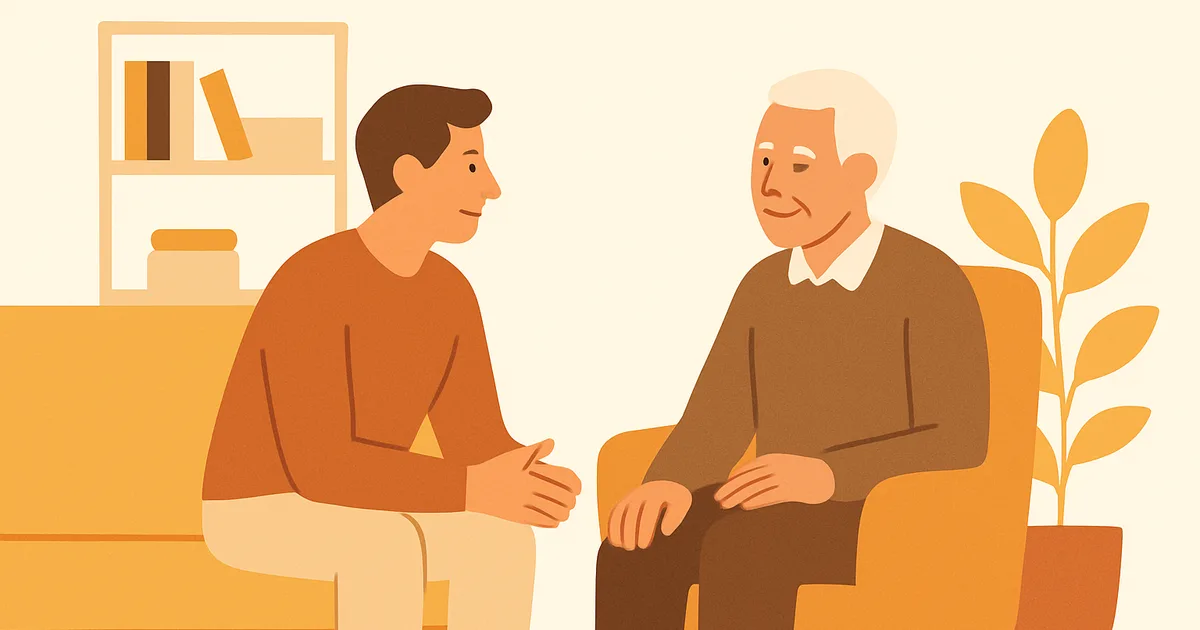
The Guilt of Moving a Parent — and Why Care Is Not Abandonment
The guilt of moving a parent into care comes from love, not failure. Taking it seriously, reframing it honestly — and knowing when guilt is a signal to heed.
If moving your parent into care has left you lying awake with guilt, start here: the guilt is real, it deserves respect — and it is not evidence that you've done something wrong. Almost every son, daughter and spouse who makes this decision feels it. The ones who feel it most are usually the ones who love most. This article takes the feeling seriously first, and only then, carefully, takes it apart.
Caregiver guilt is the persistent feeling of having fallen short of what you "should" have done for someone you love — measured not against what was actually possible, but against an ideal in which you had limitless time, strength and money.
Read that definition again, because the last clause is where the trouble lives. Guilt compares you to a version of yourself that does not exist.
Take the guilt seriously — it comes from somewhere real
The guilt has honourable roots. It comes from love: you promised yourself you'd always be there, and this feels like breaking that promise. And it comes from culture: South Africans across every community grow up with the deep conviction that family looks after its own — that a parent who raised you is owed your own hands, your own roof, your own years. Ubuntu, filial duty, "we don't put our people in homes": these are not shallow ideas, and you can't reason them away in an afternoon.
So don't let anyone — including this article — rush you past the feeling. A guilt this widespread and this heartfelt isn't a malfunction. It's the sound of a promise being renegotiated. The question is whether the promise was ever "I will personally perform every act of your care" — or whether it was "I will make sure you are loved and looked after." Those are different promises, and only one of them was ever actually yours to keep.
The reframe: choosing care is looking after your own
Here is the reframing, offered carefully rather than cheaply. Family looking after its own has never meant family doing everything with its own hands — we have always brought in the doctor, the physiotherapist, the hospital when the need outgrew the household. Round-the-clock frailty is such a need. When your mother needs help through the night, medication managed precisely, someone present at 3am — love alone cannot safely provide that, no matter how fierce. One exhausted daughter cannot be three shifts of trained carers, and it is not a moral failure that arithmetic is arithmetic.
Choosing a good home is not outsourcing your love. It is your love, doing its most grown-up work: honestly assessing what your parent needs, finding people who can provide it, and staying close while they do. You looked after your own — by making sure the looking-after was real, safe and round-the-clock, rather than heroic and failing. If you're still ahead of the decision itself, our guide on how to talk to a parent about moving can help you have that conversation with dignity on both sides.
What changes after a good move
Families are consistently surprised by what a good move gives back. When the lifting, chasing and 2am vigilance pass to professionals, what remains for you is the part only you can do: being their child. You arrive with flowers instead of a blood-pressure cuff. You talk about the grandchildren instead of the pills. Many adult children say some version of the same sentence: I got my mother back — and she got her daughter back. Visits become visits again, not shifts.
Your parent often gains too, in ways home couldn't offer: company at meals, someone always within call, small routines and shared gardens instead of long silent afternoons alone. At Dayspring Gardens we deliberately keep resident numbers low so each person is known by name — and it's often the family, not the resident, who takes longest to believe the move was a kindness. Our guide to helping a parent settle in covers those wobbly first weeks.
The guilt that lingers — and how families carry it
Even after a demonstrably good move, guilt rarely vanishes on schedule. It flares on the drive home after visits, on the anniversary of the move, when your father asks when he's coming home. Expect that. Grief often dresses as guilt: what you're mourning is the family home, an era, the parent of your childhood — losses that were coming regardless of your decision.
What helps families process it: visiting regularly enough that the new normal becomes ordinary; saying the guilt out loud to a sibling, a friend, a pastor or a counsellor rather than letting it circle privately; and judging the decision by evidence — is she safer, better fed, less alone? — rather than by the ache. If the ache is compounded by sheer depletion, read our piece on caregiver burnout; guilt lands hardest on carers who are already empty.
When guilt is a signal — and when it's just a feeling
One honest caveat. Sometimes guilt is not noise but information. If your unease keeps attaching to specifics — your father seems sedated, unclean or ignored; staff dodge your questions; your instinct tightens every visit — that is not neurotic guilt, that is your judgement working, and it may mean the home is wrong, not the decision. Raise it directly with the management; a good home will engage, not deflect. If it doesn't, move him. Choosing care was right; this particular care may not be.
But if the home is warm, the answers are straight, and your parent is gradually settling while you still ache — that guilt is a feeling to be carried gently, not a verdict to be obeyed. Feelings are real; they are not always true.
Questions families actually ask
How do I stop feeling guilty about moving my mother into a care home? You may not stop entirely, and that's all right — guilt this deep comes from love, not wrongdoing. What helps most is evidence: visit often, watch whether she is safer, better fed and less lonely than before, and notice that you are becoming her daughter or son again instead of her exhausted nurse. Judge the decision by her life now, not by the feeling in your chest.
Is moving a parent into assisted living abandoning them? No. Abandonment is withdrawing your love and presence; a good care home changes neither. You are not handing your parent over — you are adding trained people, safety and company to the care you already give, because their needs have grown beyond what one family can safely provide at home. You remain their child, their advocate and their closest visitor.
Why do I still feel guilty when I know the care home was the right decision? Because guilt tracks love and loss, not logic. The move usually marks a real loss — the family home, an era, a version of your parent — and grief often wears guilt's clothing. Most families find the feeling softens over months as visits become ordinary and they see their parent settled, but a residue can remain. Carrying some of it gently is normal, not a verdict.
What if my parent says I'm abandoning them by moving them? Hear the fear underneath the accusation — of change, of loss of control, of being forgotten — and answer that rather than defending yourself. Keep visiting predictably, keep them involved in choices, and give it time; most people settle within weeks. If distress persists well beyond that, or your own unease keeps pointing at the home itself, take it seriously and reassess the fit.
A gentle next step
Wherever you are — deciding, moving, or lying awake afterwards — you don't have to carry this reasoning alone. Our Choosing Senior Care guide walks through the practical decisions calmly, and if it would help to talk to people who sit with this guilt alongside families every week, talk to us. Loving your parent was never in question. It's why this hurts — and why you'll get it right.